Educational guides designed to help people better understand cryptocurrency, digital assets, and the rapidly evolving financial system.
Educational guides designed to help people better understand cryptocurrency, digital assets, and the rapidly evolving financial system.
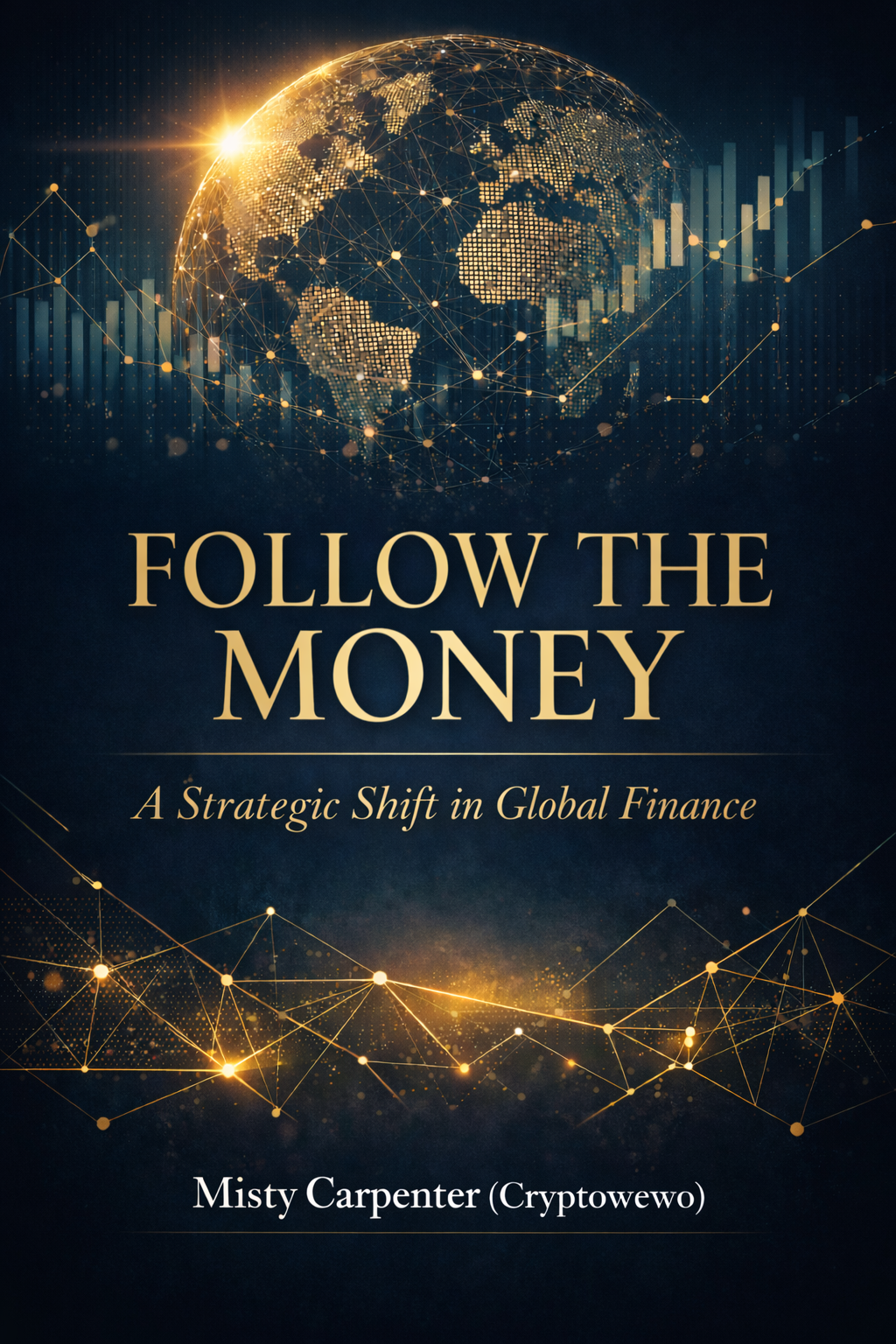
Follow the Money explores the deeper forces shaping the future of digital finance and the global financial system. As blockchain technology continues integrating with traditional financial infrastructure, governments, institutions, and technology companies are quietly building the foundations of a new financial era.
Rather than focusing on short-term market speculation, this book examines the broader structural changes taking place behind the scenes. From institutional adoption and tokenization of real-world assets to digital identity systems, compliance frameworks, and interoperability between networks, Follow the Money connects the dots between emerging technologies and the evolving financial landscape.
Through clear explanations and big-picture analysis, the book helps readers understand how different sectors of the digital asset ecosystem are developing and why these changes may reshape the way value, ownership, and financial access work in the future.
Inside the book, readers will explore:
• The rise of blockchain infrastructure in global finance
• Institutional adoption and what it signals about the future
• Tokenization of real-world assets and digital markets
• The role of digital identity and compliance frameworks
• How financial systems evolve through technological shifts
• Where retail participants fit as institutions enter the space
Written in a clear, accessible style, Follow the Money helps readers step back from market noise and focus on the larger transformation unfolding across finance and technology.
The goal is simple: to help people understand what is changing, why it matters, and how awareness of these shifts can help them navigate the future with clarity.
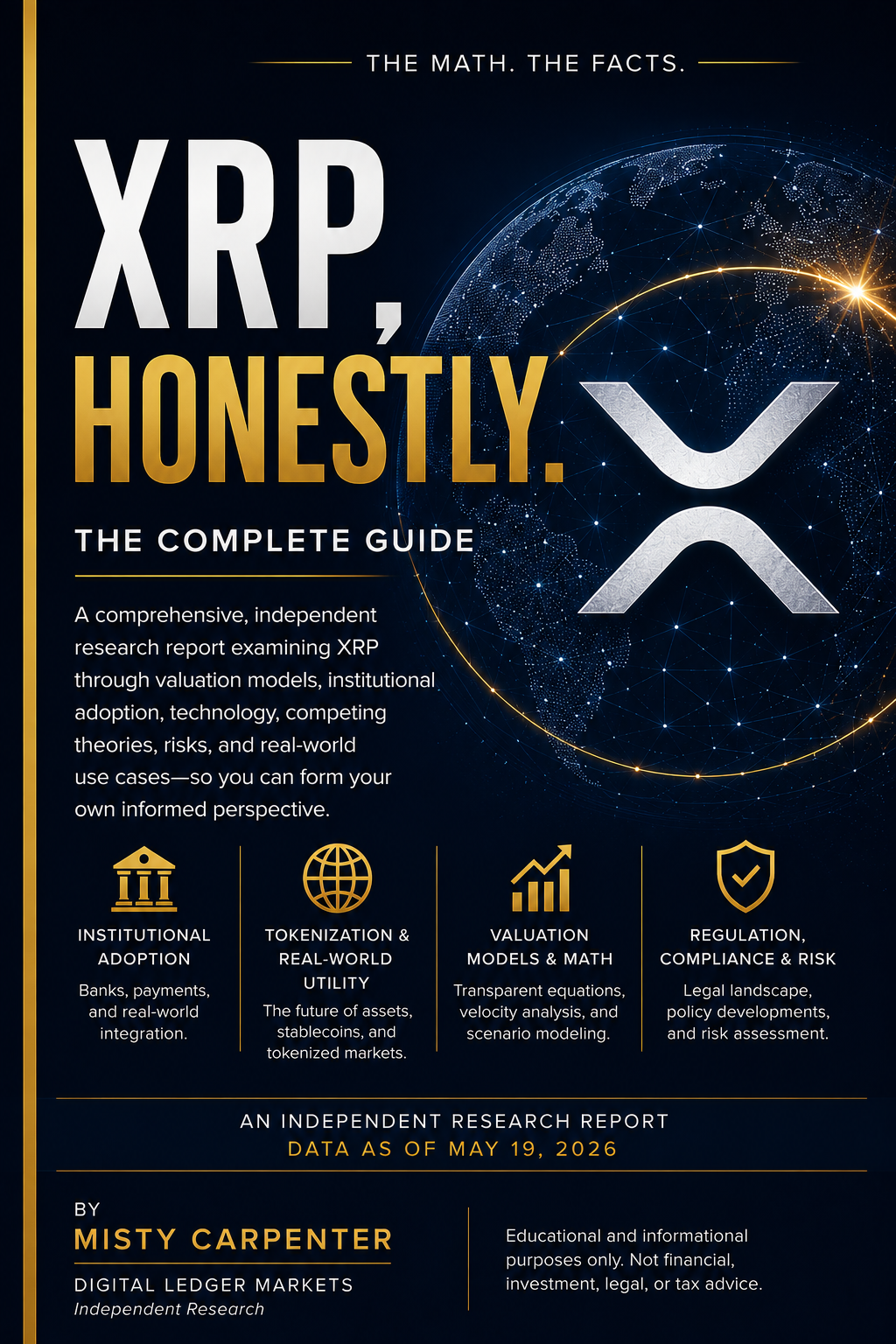
XRP, Honestly: The Complete Guide is an independent research report designed to cut through the noise and examine XRP through facts, math, probability, and real-world adoption. This report explores XRP's history, utility, valuation models, institutional adoption, Ripple's expanding ecosystem, ETFs, RLUSD, tokenization, regulatory developments, competing technologies, and many of the most popular theories circulating within the XRP community.
Rather than relying on hype, this guide applies a consistent analytical framework to evaluate both bullish and bearish arguments, helping readers understand where potential value may come from, what assumptions drive various price projections, and what risks remain. Whether you are new to XRP or have been following the asset for years, this report is designed to provide a balanced, educational, and thought-provoking perspective on one of the most discussed digital assets in the market today.
This report is provided for educational and informational purposes only and should not be considered financial, investment, legal, or tax advice.
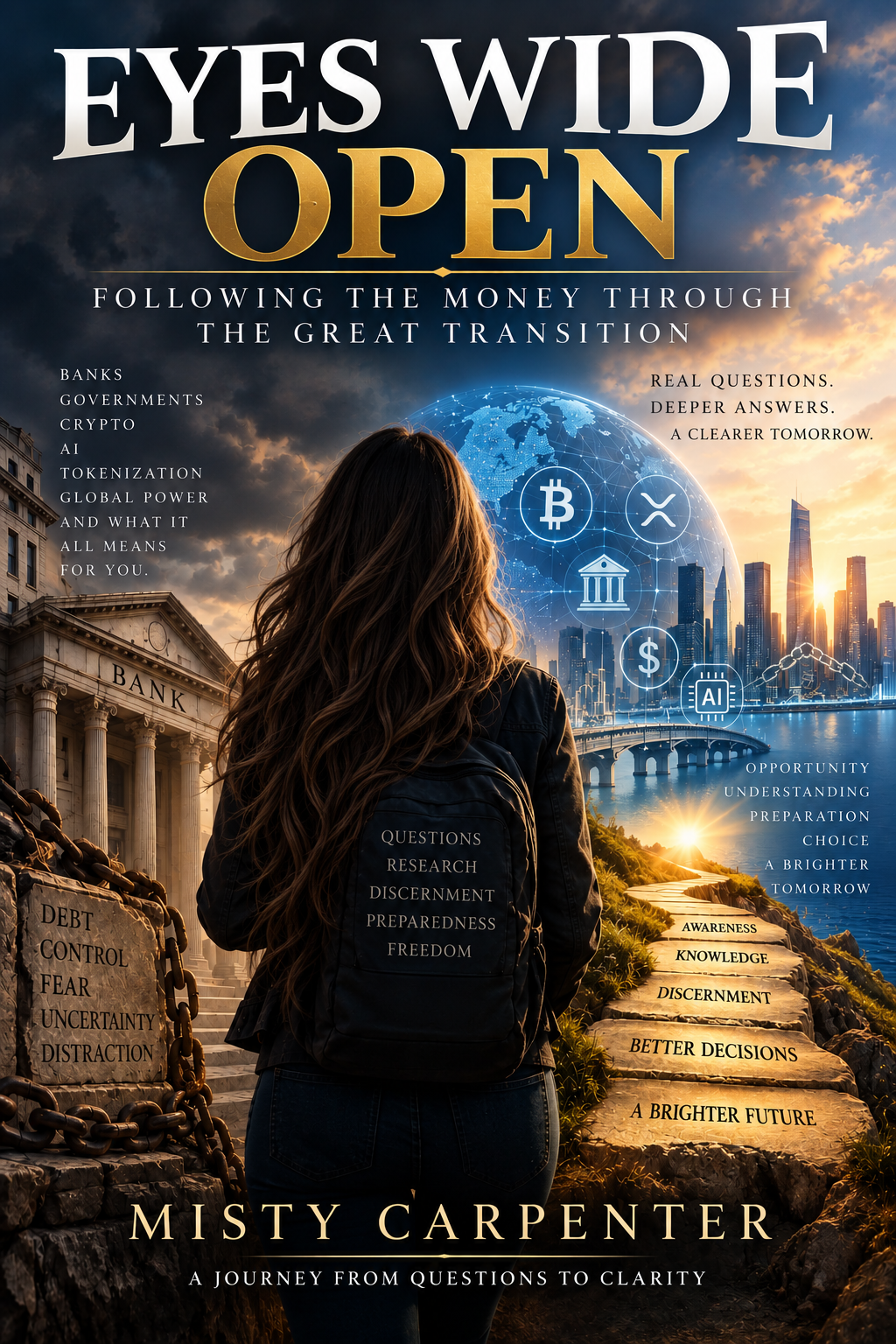
Something is changing beneath the surface of the global financial system.
Money is becoming programmable. Assets are being tokenized. Stablecoins are connecting blockchain networks to traditional currencies and government debt. Banks and financial institutions are experimenting with new settlement infrastructure. Artificial intelligence is becoming an economic force. Digital identity is expanding. Governments are confronting rising debt, geopolitical competition, and a financial system built for a world that is rapidly changing.
And somewhere in the middle of all of it are ordinary people like me trying to figure out what is actually true.
EYES WIDE OPEN: Following the Money Through the Great Transition began with my questions about cryptocurrency. I wanted to understand which assets had real utility, which projects might survive, and whether the enormous predictions I kept hearing had any basis in reality.
But every answer led me to another question.
I couldn't understand XRP without understanding cross-border payments. I couldn't understand cross-border payments without understanding liquidity. I couldn't understand liquidity without understanding banks, currencies, Treasury markets, and government debt. Stablecoins led me into Treasury securities. Tokenization led me into settlement and collateral. Interoperability led me into SWIFT, ISO 20022, oracles, and blockchain networks. Artificial intelligence led me into machine payments, data centers, semiconductors, and energy. Digital identity led me into privacy, surveillance, and questions about control.
Before I knew it, I wasn't researching cryptocurrency anymore.
I was following the money through the entire system.
And, of course, that meant eventually going down the rabbit holes.
Is XRP really positioned to become part of global settlement? Is there a predetermined institutional price? Could retail investors eventually be locked out? Are certain cryptocurrencies really “ISO 20022 coins”? Is SWIFT being replaced? Are BRICS nations preparing to challenge the dollar? Is a gold-backed financial reset coming? What is actually behind the Quantum Financial System, NESARA, GESARA, CBDCs, programmable money, digital identity, and the growing connection between finance and artificial intelligence?
I didn't want to blindly believe these claims.
But I didn't want to dismiss them simply because they sounded crazy either.
So I started asking a different set of questions.
Where does the money actually come from? Who holds the assets? How does settlement really work? What does the original document actually say? Is something a proposal, an experiment, a pilot, or a production system? Who benefits? Who controls it? What financial mechanism would have to exist for the claim to work?
And most importantly:
What would prove me wrong?
Some rabbit holes fell apart when I brought the flashlight into them.
Others became far more interesting.
And some led me to documented changes taking place across finance and technology that may be significant enough without any conspiracy theory attached to them.
This book is not about convincing you that I know exactly what happens next.
I don't.
I am a mother, a small-business owner, an investor, and a Christian who started asking questions because I wanted to understand the world my family was walking into. The deeper I went, the more I realized that understanding this transition isn't only about finding the next investment.
It's about understanding money.
It's about understanding power.
It's about understanding technology.
It's about understanding who controls the infrastructure we increasingly depend on.
And it's about learning how to prepare for uncertainty without allowing fear to consume the life we're living right now.
I still believe extraordinary opportunities may exist in the transition ahead. I also believe extraordinary claims require evidence.
So in this book, we're going to investigate both.
Follow the money.
Follow the infrastructure.
Follow the power.
Follow the evidence.
Somewhere along the way, I stopped searching for someone to tell me what the future would be.
I learned how to investigate it for myself.
And that is what I hope this book gives you.
Not fear.
Not certainty.
A flashlight.
Because we are absolutely going down the rabbit holes.
This time, we're going in with our eyes wide open.
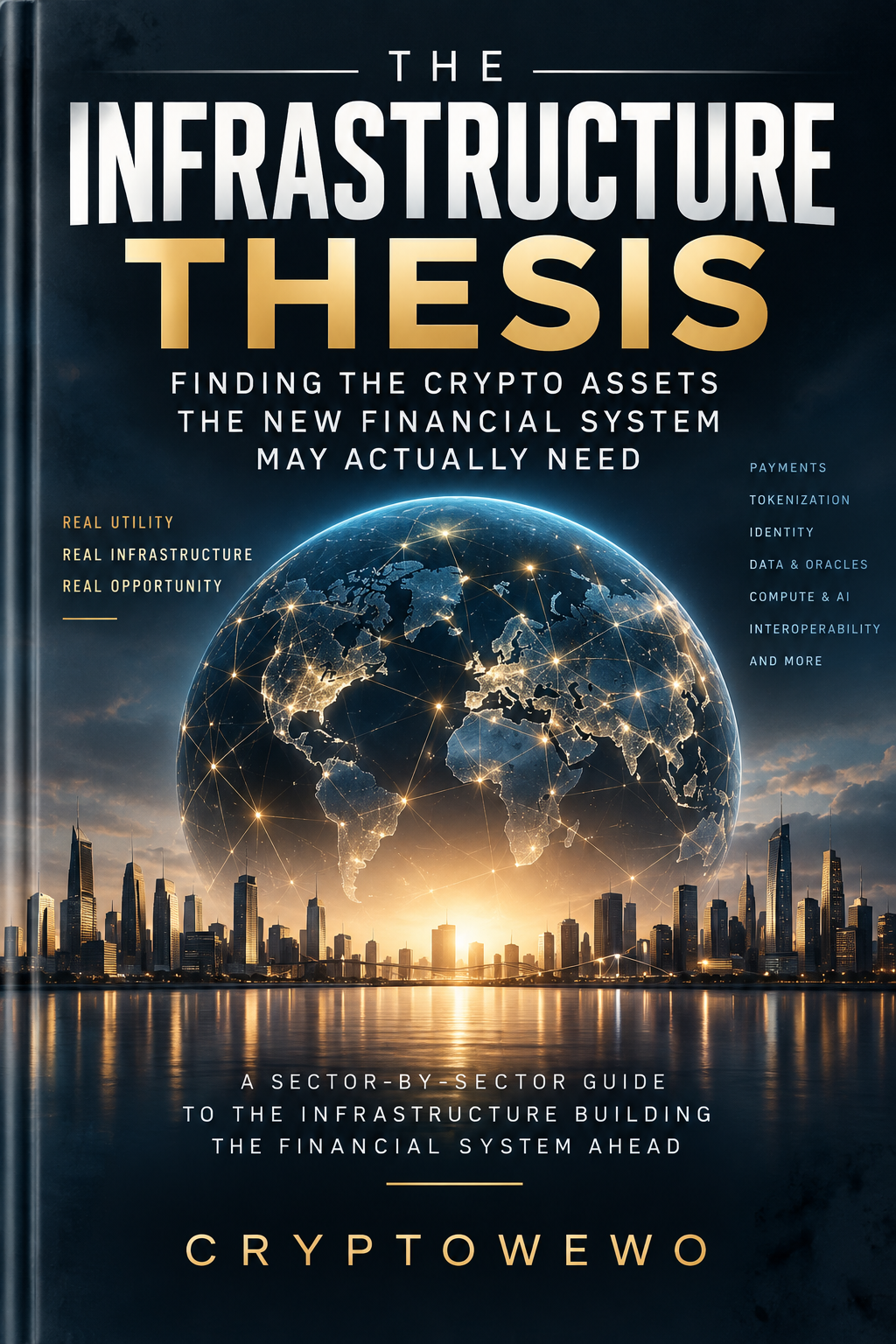
The financial system is changing but the real opportunity may not be finding the next cryptocurrency to pump. It may be understanding the infrastructure being built underneath the future of money.
The Infrastructure Thesis takes a sector-by-sector look at the cryptocurrency projects competing to become part of an increasingly digital, tokenized, programmable, and interconnected financial system.
Instead of starting with a token and trying to justify why it should succeed, this book starts with a different question:
What will the financial system of the future actually need?
Payments and settlement. Interoperability. Oracles and data. Tokenization. DeFi. Artificial intelligence and decentralized computing. Identity and compliance. Trade finance. Storage. Smart-contract platforms. Liquidity and more.
From there, we examine the projects competing to provide that infrastructure and separate the narrative from the evidence.
Each project is evaluated beyond price predictions and partnership headlines. We look at real utility, technology, adoption, tokenomics, competition, institutional positioning, regulatory survivability, security, value capture, and one of the most important questions in crypto:
If the technology succeeds, does the token actually benefit?
The goal isn't to predict one cryptocurrency that will “replace the financial system.” It's to identify the critical infrastructure layers that may be needed, determine which projects are best positioned within them, and understand the risks that could cause those investment theses to fail.
Some assets may become core infrastructure. Some may offer asymmetric opportunities. Some may have incredible technology but weak token economics. And some projects that survived previous crypto cycles may not survive the next stage of the industry's evolution.
The Infrastructure Thesis is about following the infrastructure, following the evidence, and investing with your eyes wide open.
For educational purposes only. Nothing in this book constitutes financial or investment advice.